
About the Episode
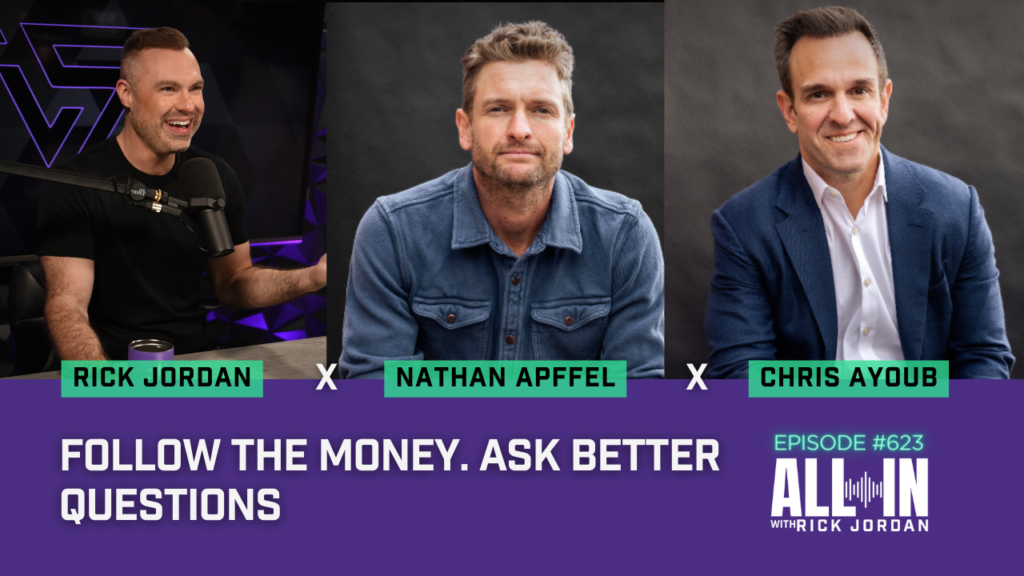
Today, we’re going straight into a topic that’s controversial for a reason—because it hits the intersection of faith, money, and accountability. I sat down with Nathan Apffel, an Emmy-winning filmmaker, and Chris Ayoub, a combat veteran with serious business experience, and these guys are building a docu-series and a bigger movement around a question most people avoid: why is the religious nonprofit space often the least transparent of all? We talk about the legal architecture that’s created a “black room” for accountability, how the IRS guidelines and religious exemptions can be exploited, and why the system has become a breeding ground for fraud, waste, and abuse—without blaming every church or attacking faith itself.
Nathan and Chris break down the difference between for-profit, nonprofit, and religious-exempt nonprofit “sandboxes,” and why the one that should be the most humble and honest often has the least oversight. We get into tithing, the business side of ministry, and the real-world ways money can get misused—from what happens between the offering plate and the bank deposit to the modern tech that can quietly turn generosity into recurring revenue. But what I respect most is this: they’re not just throwing a grenade and running away. They’re pushing for reform, building solutions, and trying to give donors the power to ask better questions—so the good churches can thrive, the bad actors can’t hide, and the impact can finally match the resources.
About Nathan Apffel and Chris Ayoub:
Nathan Apffel, an Emmy-winning filmmaker, and Chris Ayoub, a seasoned leader with military and business experience, are dedicated to exposing flaws in religious and nonprofit institutions through their upcoming docuseries, The Religion Business. Their work challenges the status quo, promotes transparency, and seeks community-driven solutions for meaningful reform, aiming to create a better world for future generations.
Watch the episode here
Episode Topics:
- You’ll learn how religious exemptions created a massive accountability gap—and why it matters.
- Nathan Apffel and Chris Ayoub reveal the loopholes most donors don’t even know exist.
- We unpack tithing, transparency, and the uncomfortable realities behind “church business.”
- This conversation isn’t about tearing faith down—it’s about reforming what’s broken.
- If you’ve ever wondered where the money goes, this episode will change how you think.
Rick Jordan
What’s shaking? Hey, I’m Rick Jordan, and today we’re going all in, all right? Today we’re going to jump into some controversy, which is freaking fantastic, because this stuff is near and dear to my heart. Growing up in a church, setting myself and always seeing, you know, the if I could say the poorness of pastors and just this weird view and perspective around money, I got news for you. Everybody’s meant to have resources. And we’re going to dive into a cool conversation with two dudes today who are right at the forefront of this type of controversial discussion. We’ve got Nathan Apfel, what’s shaking my man, and Chris Ayoub, welcome to all in.
Nathan Apfell
What’s up, Rick?
Rick Jordan
Guys, it’s a, I’m pumped for this because, I mean, Nathan, you’re an Emmy winning filmmaker, which is freaking fantastic. You know, Chris, you’ve got military and business experience, which I have a lot of friends that have that amazing combination. First off for you two, how did you get together?
Nathan Apfell
Well, we’ve been dating for years. Chris, you can tell the story. You’re good at this.
Chris Ayoub
Yeah. So prior, prior to this, I was the president of a large homeowner association management firm.
Chris Ayoub
And that’s so sexy.
Chris Ayoub
By the way. Oh, industries, by the way, guys, I kind of feel left out that I’m not wearing a black T-shirt.
Rick Jordan
Yeah, where’s the memo, man? I mean, we’re going to talk about that. I’ll give my team on that and send it out ahead of time.
Chris Ayoub
Exactly. Yeah, I was when I was exiting from that industry on the day-to-day side, I was figuring out, okay, hey, the next thing I want to do, I really want to make it. I want to make an impact, not just in corporate America. What’s up for humanity? And so I started exploring was looking in the mental health space. I’m a combat veteran. So very dear. Dear to my heart is the whole mental health side of things. And I came across a gentleman who was in the same industry as me and the HOA side, and he was telling me about his two-time Emmy award-winning filmmaker friend, Nathan Apfel, who’s been on this journey. And at that point in time, Nathan had been on this journey for 10 years, and he wanted me to meet him as a potential business partner, akin was at a point where, you know, he had filmed 60% was really looking for not just, not just a capital partner, but an actual, you know, brother, to be in the trenches with on this, because this is a huge thing to take on, yeah, and that’s how we met, and I’m like, the future looks bright.
Rick Jordan
Yep, that’s awesome. I love how I started into this too, because it’s intriguing, because you guys are talking about the, you know, really, like, the business of religion, you know. And when I, when I was involved in the church scene, being an ordained pastor, right? I actually helped found three churches. I was always the number two guy, and I always, always saw this business aspect of things, you know, from a productive perspective. But what you’re diving into is not the productive perspective at all, of the business of religion.
Nathan Apfell
Yeah, we’re diving into the kind of a legal architecture that undergirds the the the entire nonprofit sector, and then the religious exemptions in particular in America. Well, I had a very interesting conversation yesterday with with a very high profile pastor, and he was like, we just he’s like, You have to ask just one question to every pastor and they’ll melt. And it’s why aren’t you being honest? And what we we basically present the argument that in the US, there’s three different sandboxes that you could play in from a business perspective, there’s the for profit world, there’s the nonprofit world, and then within that sandbox of the nonprofit world, there’s the religious exemptions, religious nonprofit and when you look at all three of those sectors, you’d say, Okay, which one should be the most accountable, the most transparent, you know, have the most integrity, be the most humble. And you’d think it’d be the religious sector. But of those three, it’s the darkest, most shadowy in regards to any type of accountability or transparency. And it’s not one person’s fault. It’s, it’s really just the legal architecture here in the US has has allowed this, what was a mouse sized problem, to become an elephant size problem in the last 60 ish years?
Rick Jordan
Yeah, for sure, I definitely want to dive into that. I will never forget guys, and I don’t, I don’t think I’ve ever told this story, but it makes sense for today. When I was, I was probably 1516, years old, because I said I grew up in a church, right? The denomination was the Assemblies of God, right? With a with a Pentecostal background and everything. And the business of this religion was something I learned about early where the, you know, everyone understands the concept of a tithe, right? And that’s something that is. Is, you know, there’s several passages in the Bible that are tried to be referenced to say, Hey, this is what you got to do, right? And which, by the way, I’m much more evolved than that at this point, you know, because it’s not this hard and fast rule. But I remember that the pastors of the churches that are employed by the churches as the pastors in the Assemblies of God, their 10% is owed to the district, to the structure, to the organization. And I will never forget this. It was like a collection call that the youth pastor got from the district, and he told me about it, and the way that they went into this was like, you know, you didn’t send your tithe into the district this month. And he’s like, Oh, whatever, you know, times are tough or whatever. I think I just forgot, you know, it was something, some normal human reason, yeah, you know, some normal human reason. And I remember the questions like, Well, did you pay your light bill last month? Did you pay your mortgage last month? Yeah, you know. So it was those types of questions, and I’m sure this is part of what you guys dive into, right? Is this kind of weirdness?
Nathan Apfell
Well, it’s it really, this is that is the linchpin to the Christian problem in in the system the, you know, Judaism, Islam, Buddhism, Hinduism, they have different forms of giving than Christianity, yeah, but I was raised in the same milk, like, hey, Nathan, here’s your birthday money. Go give 10% to your church. This is your tithe. And I it always rubbed me wrong as a kid, because I’m like, this isn’t going to God, it’s going to this dude or this group of people. And then they get to decide what is like, look at I get it if it was going into a homeless person’s hand or an orphan’s hand or a widow’s hand that needed it. But I’m like, I don’t get why. I gotta give it to this building. And this is what I would say. One of my personal biggest adventures in the production of the show was learning this concept of tithe, this mosaic concept in the Bible, and then it goes back to Melchizedek. But what it what it does is it goes back even further than that. And I’ll tell you right now, every single church or pastor that preaches tithing will not be ready for the show, because we are going to show that everybody’s theology and belief on this is wrong, and if you say 10% you’re misguided at best, or you’re abusing it at worst, to, you know, to in your yourself and get wealthy, yeah, and you’re not going to be happy with what I’m about to what we’re about to present in the show.
Rick Jordan
Right on, I’m intrigued. I mean, normally, this is for the end, but where’s your Docu series airing streaming platform, I’m assuming, right? Yeah.
Nathan Apffel
So we produce for Amazon. So Amazon’s kind of our second base hit, and I know they probably won’t want to hear that. Our goal is to really create a national dialog and then eventually a global dialog, yeah. And so with Chris’s experience in regards to the business world, we’re looking at alternative models. We want 200 to two 50 million people to watch this in the first three months, to create a to create a global conversation about this, to where no church and religious organization or secular nonprofit can hide. You’re going to know the questions to ask. You’re going to know, you know where the butt the buttons to push, because we really are going to demand reform to the sector. And so Chris, Chris is doing some amazing work on the on kind of, let’s call them, creative collaborations, which could eventually turn into 10s of millions, if not hundreds of millions of views.
Chris Ayoub
That’s really cool. And if you know any distribution, you know platforms, Rick, we’re having those discussions right now. Yeah, because, like, another thing that was very interesting that shared, what that was shared with Nathan yesterday, with this, with this high profile pastor, it’s really, was really cool is, you know, somebody that’s been in that system for so long said that you all are going to be behind the next great reform for the church. And that’s, that’s cool, having that discussion that was really, really, I mean, it needs it, right? The nonprofit sector as a whole, it’s a $1.42 trillion market for donation. That’s 890 billion globally for Christianity, just Christianity, and then over five 40 billion for secular nonprofits. Now we were alluding this earlier. What’s the big difference between those two? Well, secular nonprofits turn a 990 in the 990 revenue, expenses, top, top salaries and such. The biggest black hole is the religious exemption side. Yeah, yeah. M A guy like, that’s, that’s how I’ve I’ve made my career so far is like, doing a lot of murders diligence, right? Yeah, they’re doing like crazy, oh, let’s. Get, let’s get this, you know, nonprofit, and scoop it under us, and we’re going to turn it into, you know, we’re going to turn it into a church. Let’s take this radio station, this TV station, like a hotel, an orchard. I mean, you name it like, yeah, it’s out of control. These conventions, associations and auxiliaries and churches like there’s a lot of lot of sandbox play in there.
Rick Jordan
Yeah, for sure, you guys have some great side spiritual balls. I’ll tell you that to go after something like this. And I admire you for that, you know, because, I mean, just just from our conversations, obviously, I think the three of us share some sort of, you know, story of a background in faith, you know, growing up and everything. I’ve been curious about this my entire life, you know. And to your point, and to your point, Nathan, I’ve always had the thought too, you know, where you said it goes to some dude, you know. And that was the thing is, like, I believe still, and I I can make the assumption and stop me if I’m off base about you guys on this. But none of us are saying the churches are bad whatsoever.
Nathan Apffel
No, you know. And we’re not saying faith is bad. We actually encourage people to explore their faith, but we’re saying these institutions that we kind of take, I use the example of, hey, everything in my purview, in this in this box, is my reality. Outside of my reality. I don’t know what is real or fake. I don’t know what’s going on. So if I was raised in a mega church, I think this is church. If you were raised in a Pentecostal church, you think that’s church. If Chris is raised in a Roman Catholic church, he thinks that’s Christian church. But what we don’t realize is these are all just man made institutions that have I was talking with this professor the other day who’s an expert in the early church, so from Christ dying and the apostles going out to really Constantine, that’s like his wheelhouse. And we were talking about this inter infection of Christianity in Rome at the time when Constantine became a Christian, Christianity, which was this organic, almost fluid philosophy, started merging with government, and good things came of it, because the Christianity influenced Rome, but then Rome also brought these institutional pillars into Christianity, and the institution was, hey, we build buildings, we organize, we build boxes and structures and and you kind of removed the organic organism of Christianity, so to speak. There was a relapse of that, which is really cool, and that’s the founding of America, right, yeah, like, after the Reformation and the Church of England kind of started falling apart. The Pilgrims found America, and they started, they said, Hey, this is awesome. We can build our own religions. We can do whatever. And there was kind of this rebirth of this organic organism. But then what do humans do? We build boxes and we build institutions, and we organize things, and we were pack rats and and so now we’re just at the, in my opinion, we’re at this death cycle, so to speak, of this institution again, where reform has to come and and so, yeah, to your point, it’s like, it’s not the we’re not discounting faith or even the church. It’s we’re saying, hey, these institutions have become so institutionalized with so little accountability, external accountability, that they’re just they’re eating themselves from the inside out, from fraud and embezzlement. And in your mind.
Rick Jordan
Yeah, this is such a cool collision of of areas of expertise and passion as well. Because, you know, Chris M and a guy, right? I just took my company public, you know, and our whole strategy is a roll up, and you talk about transparency. That’s one of the reasons I did it, because everything is out there in the open, for sure, and just like, you know, as it should be, you know, to your to your point. Nathan, everything with church should be there and righteous and good, and it’s supposed to be that way, because there’s a lot of good that that church, in its organic nature, can do, for communities, for people, for humans, for hearts, you know, for families, for everybody that exists in the entire world when, like Chris, when it’s structured the right way, and it can be transparent.
Chris Ayoub
Yeah, I want to, I want to add Rick, you just, you just brought up, we’re absolutely, you know, not saying, you know, church is bad. It goes a few levels deeper. Is what church because what’s what, what like when you’re talking about, like, doing real good for the local community. Mean, these, the whole tax exemption exists for the concept of local social capital, right? Yeah. What is a church? Well, churches have now turned into, as I said earlier, radio stations, their their private jets, their people’s homes. So what, what is a church like? We have to even start to go back and go, let’s define what a church. Really is.
Nathan Apffel
That Chris is where the whole thing falls apart, yeah, because of separation of church and state, the IRS can’t define what a church is. So pretty much anything could be a church, you know. And people have just gotten wise to that idea, and smart businessmen and women have gotten wise to that idea. And I’m not, I’m painting with a very broad brush here, because there’s a lot of really good pastors out there, but a lot of shrewd businessmen and women who don’t have the bench like most honorable of intentions, see the nonprofit sector and then the religious exemptions in particular, as a great way to make a lot of money under the table. And that’s what just I got to sit down with Philip Hackney, who’s the number three brain in the US on religious exemptions, and he’s like, Nathan, the government wants nothing to do with religious exemptions, but you guys got to get your house in order, because there’s so much you’re talking about, almost a trillion dollars a year giving, and there’s so much abuse and fraud And in your mind, pressing on it, that the whole system is going to cave in. And he’s like, he’s like, we can’t touch it, so go get your house in order, you know? So that’s what we’re here to do. We’re really here to to define what a church is, because, to Chris’s point, is a hedge fund a church. And on paper, right now, a hedge fund can be registered as a church.
Rick Jordan
Wow! I had no idea about that.
Nathan Apffel
Yeah, a for profit vehicle who’s whose entire structure is to generate profits, can be registered as a church as long as there’s one line somewhere on their documents that says, hey, one day, we’ll give it all back.
Rick Jordan
One day. And it’s like, that’s crazy.
Chris Ayoub
So much nepotism in churches. It’s generational, generational wealth just passed down churches, the board, it’s family, and then it goes to the sun, and then it goes to the Sun side, and it or the daughter, and just, it just keeps passing through. You know? I mean, that’s a huge part of it as well, too.
Nathan Apffel
That’s incredible. It’s interesting. Rick, I have a question for you, because I’ve got I’m not, I’m not a businessman. I’m a creative like I’m so grateful for Chris and his his wisdom in that regard, because he brings such a level of structure and and business ethic to things that I don’t have. But so I’m sitting here with two businessmen right now. What would be your pitch for the reason why a corporation or a company should be accountable and transparent?
Rick Jordan
Oh, man. I mean, you’re asking probably I’m going to say this in a in a confident way, the right guy for something like that, because I’m looking at the two of you, and you’re saying that the business guy, right? I’m also a creative. I mean, I made a documentary four years ago about the pandemic with, with a filmmaker from, from LA in the church realm, as the number two. I would always fill the business role, because I could, you know, putting structure to it. But I was also the worship leader. You know, I was, I was the worship pastor, you know. I mean, I go back 30 years playing guitar and drums, and my dad was a band director, and all of that too. I love the creative aspect of this. So when I took a look at the church, you know, there was a statement all the time in all the churches I was in that the pastors would make where they would say, Hey, I don’t know what anybody gives, you know? And I was like, and I was like, once I got in the inner workings, I’m like, that’s such bullshit. You of course, know what everybody gives because I’ve seen the reports. I’m in the inside as well. But then in the transparency, it’s like there was always a meeting, you know, like an annual meeting, which you had to have, or whatever, or at least they said you had to have, where there was budgets, you know, they said, Hey, this amount of money is going to these areas. And probably the church that I grew up in was the most transparent about that, you know, the three churches that I was not the guy, you know, I was always the number two. I positioned myself as the number two. I didn’t even know where everything was going in that I’m like, How can we, how can we guarantee integrity around our programs that we’re offering, and even to more. So it’s like, I never wanted to, even though all of them wanted to pay me a salary. I never took a salary from any of those, you know, because I was still building businesses. I’m like, I’m covered, and I am donating way more than 10% of what I’m bringing in because I believe in this thing. I’ve got a passion around this. I want to see this succeed. I want to see it do a lot of good for a lot of people. You know, and that’s why I’m involved in this. That’s my why is being a part of this. I have a faith, and it combines with passion to be able to help people. So can we not be transparent in this? And, oh, by the way, I don’t want a salary because I don’t want to be beholden to anybody in accomplishing that mission and that vision of my own personal self. And I also believe that the dude, as you said, Chris, the dude, I don’t believe that the dude should be paid by the church, because it does allow that separation and allows no conflict of interest, which I think could also bring a lot more transparency, you know, and I don’t know. Rick Warren. And personally, but I know that there was a point, you know, he wrote Purpose Driven Life, as I’m sure you guys dove into him, right? There was a point, at least, reportedly, he gave, like, his entire past history of salaries, back to the church at one point when he had this similar kind of epiphany, you know, and he related it to Scripture and how Paul, you know, traveled from town to town. He was a tent maker, traveled from town to town, and did not take money from the churches that he spoke at. He worked and he labored to provide for his own needs. That way he could also maintain that ethical degree of separation and transparency.
Nathan Apffel
This is Yeah, so this is my question, and this is the name of the show, the religion business, yeah. I think we need to look at these institutions, Saddleback, you know, Rick Warren. You need to look at Saddleback as a business and say, Hey, how do we run this business as streamlined as an end, as efficient and as accountable and as transparent as possible, but because of the regulations, which most of them were written in 1913 since 1913 here in the US, it’s created this opaque which, which used to be kind of hazy, but now is literally a black room, because Congress, through through tax reforms, was lobbied to add additional language in to loosen up the regulations even more. And so like you talk about that background of, Hey, your our denomination was pretty accountable. I would argue denominations had some accountability and structural oversight, but as non denominationalism skyrocketing and denominational isms crashing, yeah, it means we have it’s the Wild West. Now if all three of us are non denominational pastors in our town here, and we all have our own churches. I’m beholden to no one except who’s on my board. There’s no oversight. The government doesn’t sit above me, and there’s no denominational structure. So the abuse in the last 40 years has gotten exponentially worse, because that that denominational accountability is gone or is disappeared?
Rick Jordan
Chris, could the answer maybe be, I mean, coming from a public company now, could the answer maybe be the transparency required for a public company combined with the tax shelters for a church to actually produce something in a good way?
Chris Ayoub
Yeah, it’s like, there’s a strong argument that for capital, companies are are doing a lot more for the community than that, not nonprofits. And I also believe that the transparency and accountability, like the education for someone to know where their money’s going, how it’s being used, and being a part of that is extremely powerful. There is no education on that side. There’s not a this is where your money’s going. This is how it’s being used. Nathan just got back from Uganda and one of the nonprofits he was meeting with there you want to talk about doing excellent work. I mean, for $20,000 a month, they’re feeding hundreds of kids, providing shelter for hundreds of kids, training skills, good things, and you see how far $1 goes. Well, nonprofits like that have partnered up with churches in the United States. Those churches then take the marketing material, the suffering child. Hey, you know this offering is for these people, and they’ll take half of whatever comes for them. And so it’s like, it’s, it’s, it’s just, it’s just such a dark hole that, until you have accountability and transparency into it, oh, people, people’s expectations, right? You know, only 3% of donors never follow up to ask whether their money goes like we kind of all need to have, like this awakening in a sense of saying you would never invest in a company. These are investments we’re making in humanity. It’s investments we’re making in social capital. You wouldn’t invest money into a company blindly without knowing you know private or public, like, what financial situation here?
Nathan Apffel
Rick, here’s a great transition to Chris’s point. The Christian Church has enough resources right now that flushes it in annually to solve the top 20 global social issues. And it would affect this is what’s crazy. No one’s bottom line
Rick Jordan
That’s amazing.
Nathan Apfell
Kenneth Copeland, they could still take their salaries and fly on their private jets. The only thing we would have to solve is the theft portion of it. So because there’s no accountability, 53 billion, and this, this data is a couple years old now, and I’m going to drop a bomb on you, 53 billion is stolen internally by church staff every year. Wow. That is a voluntary data given, that’s voluntary data given from A to A think tank. So this think tank just pulls churches and says, Hey, you know what you brought it on a Sunday compared to what you dropped into your bank account. What was the Delta and 53 billion? And I believe that data is 2022 so they texted me a couple weeks ago and they said, hey, guess what? 2024 is shaping up to be. And. I said, How much? And they said, 86 billion. The reason is, is in this is it’s not rocket science as to why, because as technology expands and develops, the laws and regulations can’t keep up with it, and so there’s just more and more ways to take money from people and glean money from people, from reoccurring payments that people don’t know they’re signing up for to reoccurring donations. And so there’s the thing, if we just stop the theft, the church could solve the top 20 global social issues, and it would affect no one’s bottom line. If the church just steered a small portion of its resources on top of that, to solving global social issues, it could solve the top 30. You could still have the buildings and the big worship bands and the salaries and the donuts and the coffee bars and all that, and the Christian church could radically transform the world tomorrow. And my argument is, if it just kind of mirrored its Savior a little bit more.
Rick Jordan
Yeah. How does that stuff take place? I mean, Chris, I’m sure you can speak to this because, I mean, I’m thinking like old school days, right in the church, passing around the offering plate, cash getting dropped in. You know what happens? Is it the back room where they’re counting it that they’re stuffing into their pockets?
Chris Ayoub
That’s a big that’s a big, lot of it, friends, from the time it gets collected between that and the times that, the time that it would get recognized in the accounts.
Rick Jordan
Wow.
Nathan Apfell
That does not include, that does not include, you know, embezzlement in in your mint. So a great story is a Joel Osteen church who, you know, big, great, big pastor down in Houston, runs Lakewood. They had a plumbing issue in one of the bathrooms, and this, this is a few years ago now, and so they brought a plumber in, and he tears off the drywall. And behind the drywall was 600,000 in cash. So someone, someone who was collecting the offering plates every Sunday would run into the back and stuff a couple 100 in their pockets, and all got to go to the bathroom, and then they drop it down the air vent, you know, in the wall, just for their retirement. You know, fun. So someone was stacking, had stacked 600,000 in cash from the operating, operating offering plates.
Rick Jordan
That is insane. It’s almost like it you would want to be like, I was at Six Flags of all places on Monday, right, with my kids and then, and they don’t even accept cash anymore there at the concession stands and all that. It’s just cards. It’s almost like it would be safer in some ways. It’d be like, hey, sure, digital payments only, you know, digital donations only, rather than cash.
Nathan Apffel
Yeah, this is one thing that Chris, Chris can talk to is we’re not just here to solve like, bang our drum that, Hey, there’s this major problem. We’re here to solve it with some tech solutions. But right now, technology has been leveraged strictly to milk people for more money. So there’s a couple technologies in the church, and they guarantee on their websites. One of them says, hey, you know, we will 10x 10x the revenues we pull from people. And you look at their model, and all they’re doing is having old people sign up for reoccurring payments, and who, in their right or who in their humble mind, would go ask the church for their money back.
Rick Jordan
So these are consultancy businesses, financial like church, religious consultancy businesses that will just demand.
Nathan Apfell
Yeah, there’s one that says, hey, we will get your caller against to give you stock. So we have this app now where they can donate stock, and they say, We will 34x you’re giving. And you say, How is this possible? It’s because people don’t know. They can’t do the math right off hand. Oh man, you know what? I donate a couple shares of Apple today. They didn’t realize they just donated 800 bucks. You know, maybe they, maybe they thought they were gonna donate 100 or 200 but So and these, these guys, these apps, are Christian apps, but there’s no, when you look at their website, there’s no like, hey, we want to bring accountability into the system. Hey, we want to help better steward resources. It’s, we will tend to 34x you’re giving. We will streamline things, make you more efficient. And they call it generosity.
Rick Jordan
It’s crazy. It’s like you go to one car and they’re stuffing things inside the payment, and they’ll show you the numbers to go that back into it.
Nathan Apffel
It’s the exact that’s a great analogy.
Chris Ayoub
Yeah. So in the Yeah, I mentioned this earlier. Nathan’s been working on this for over over a decade, done a ton of research, read tons of books, met with people all across the world. And Joe it’s investigated journalism, and through that process, he’s identified seven, eight loopholes that a lot of this fraud, waste, abuse, and you’re inhabited. And when we went at this together and said, Hey, we’re going to partner up, we’re going to do this, there was two there was two big things. Number one is that we’re coming at this from a place of love. This isn’t anger, this isn’t we want to tear the place now. We want to come at this with a place of love, right? We have a higher expectation for the faith we were raised in. This is out of love. Humans will human. We’re all imperfect victims of a system, whatever you want to call it, but we’re, you know, we’re human. The second one is, we are going to sit here, toss a grenade and run away. Okay, a lot of people can. Do that a lot of people.
Rick Jordan
Because Docu series and documentaries are, yeah, for sure.
Chris Ayoub
Copy Man in the Arena. We’re here. We’re here, you know, to be in that arena. We’re here to bring a solution to market. So we have a software platform that is very multi purpose. It, it’s an accountability one, housing and accountability. One well, for like, a lot of the information that secular nonprofits would provide on a 990 we’re going to be gathering that, that that data, you know, revenue, expenses, officer, salaries, what? Let’s see a copy of your P and L How are you spending your money on missions? What are your missions? Those types of, those types of things. What is your pastor’s salary? Do they receive a housing stipend? Because there a lot of cuteness there, which, I make $100,000 a year, but I receive a $15,000 a month housing stipend. So there’s a lot of that there. So think, Hey, we’re not saying that x percent of you know, because the number is about 44% goes to salaries. We’re not here to say that should be the benchmark. It should be less. It should be more. We’re here to say all the people that are donating how the money’s being used, so they can make an educated decision if they’re cool with that. It’s a free country. Let them donate where they want to, but let them be empowered and then the ability to engage and ask questions and follow up. I mentioned to you earlier, only 3% of people who donate actually follow up see where their money’s going and opportunities to volunteer. The beautiful part is, is that while all this data is being gathered, we’re calculating a light rating, a light score that shows how transparent they are, and you’re able to read graphically, of course, where you’re going with churches on the secular nonprofit side. It’s kind of think about it as a dating app, in a sense, you’re aligned with your interest. I’m interested in mental health. Well, I’m going to get aligned with and mental health nonprofits, I’m going to be able to see how transparent they are, and then should I choose to I can make a donation, and it’ll facilitate the donation for them. So that’s that’s what we’re out here to accomplish. There’s all these global social issues that are not being solved, and there’s a strong argument that they don’t get solved because there’s so much money that’s involved in it. Money that’s involved in it. Like, once a problem solved, what did that entity need to dissolve? But it’s hard as a human to walk away from something when that’s your identity and that’s that’s your income, yeah, because you were saying about, like, being beholden to, as it relates to the pastor side of things. So that’s where, that’s where we’re headed.
Rick Jordan
Man, that’s really cool, because I can, I can envision this, and I’m sure you already have right I see, I see a site stop me where I’m wrong, right? To where it’s almost like a voluntary participation. And it could be, and it would actually be better for church organizations to volunteer their information first. I mean, we’re talking about the legal reform that has to be done, the tax reform that has to be done regardless, right? So it’s written in the law. But then even if that didn’t happen, because, I mean, that’s a big battle, as I’m sure you guys have discovered, that’s a big battle you’re in. But if churches, and you know, other nonprofits, would volunteer their information for this. They would actually probably 10x or 34x, their givings just from being transparent.
Nathan Apffel
Well, that’s what, yeah, that’s the conversation that I have, I had yesterday is the guy was like, Well, only, you know, only 2% is given to the the church annually. And I’m like, Well, maybe if you want more from people, you should show them where their money’s gone. Yeah? Because if, hey, if, all of a sudden, I’m like, Hey, Rick, you know our app, we’ve, we’ve dropped the global deaths from malaria, because there’s a cause we’re focusing on. If we drop the global debt.
Rick Jordan
there wasn’t Bill Gates that did it, yeah,
Nathan Apffel
from 1.6 million a year to 1.1 so, like, dude, in the last three years, we’ve cut 30% of deaths, 300,000 or whatever that is, four, 500,000 lives. Like, and you gave 100 bucks last year. Can you do 200 because we really want to eradicate this. Yeah, you’d be like, Heck, yeah, dude, let’s do it. Because you want to know what we see, the impact. We see, the global response. And like, Yeah, this is it. So Chris and I are all about this. We are here to bring democracy back into institutions. Because right now, churches and nonprofits are built like little authoritarian huts. You know, it’s a few people control massive resources, sometimes with no accountability. So we want to flip the pyramid and say, hey, it’s the donor who has all the power and they expect performance and impact from their leaders, whether that be their religious leaders or their nonprofit their secular nonprofit leaders.
Rick Jordan
That’s so cool. I mean, you guys are actually looking this done the way that you’re doing it is actually meant to expand the reach of the church. 100% freaking incredible. Yeah.
Chris Ayoub
Hey, Rick, I was gonna, I was gonna share this with you. I’ve, you know, I’m newer to this, this journey with Nathan, like I said, he’s been on this for over a and there was some pretty cool aha moments I’ve had throughout that just would love to throw, throw some brand and trivia at you, just to kind of see, see if it’s a light bulb moment for you as well, too.
Rick Jordan
It’s like a lightning round at the end of the episode, let’s go, yeah.
Chris Ayoub
All right, how many denominations are there within Christianity, across across the globe?
Rick Jordan
Oh, geez, I would venture several 1000. Yeah, it’s north of 40,000 Holy moly. Yeah, I wasn’t thinking that. I was thinking like 8000 but,
Chris Ayoub
Yeah, how many churches are in the United States?
Rick Jordan
Oh, if you’re getting into home churches and all that, I mean, you’re probably talking not enough registered, registered, I got you, I would still say probably in the hundreds of 1000s. Yeah, 444, 100,000
Nathan Apffel
how many? How many Starbucks?
Rick Jordan
Where are they at now? Is it like the 40,000 stores, something like that?
Chris Ayoub
Yeah, it’s less. It’s less. Yes,
Nathan Apffel
Starbucks is around every corner, right? Yep. And there’s 400,000 churches. I think there’s 16,000 Starbucks. Wow. There’s 13 to 16,000 I think there’s 13,000 McDonald’s, which are on every corner, and 16,000 Starbucks. There are 400,000 churches.
Rick Jordan
Oh my gosh. Well, this is a new church right here, right the all in church, exactly. Bit of a crass joke, but it’s just as realistic as how you’re painting it is that could legitimately be. You’re right.
Nathan Apffel
Well, so since the IRS can’t define what a church is on paper, you know, they can define a corporation, yeah, you know, they can define a an expense allocation on a, on a, you know, tax document, but they can’t legally define the word church because of separation church and state. So they have this thing called the IRS guidelines. And you learn about this in the show, there’s 14 guidelines, wow. And of those 14 guidelines, you only have to check a couple. And it’s really simple. It’s you have to have a creed. So whether, like, let’s say you’re the nice and creed, or the creed of all in Yeah, or the creed of of Chris, and then you have to meet, and this is a big one that’s gonna or the creed. I mean, they’re making a comeback, yeah, exactly. So you have to have a creed, you have to formally meet in person. And this is what’s gonna blow a lot of young pastors minds, is they’re trying to move their churches online. The government does not see church as an online church, wow. So if you move strictly online, you are no longer a church and will lose your exemptions. People are just so arrogant or naive, let’s say, to the tax guidelines, that they don’t even know what they’re doing. But then another one is you have to meet at a minimum once a month in person. So now you have pastors running churches where they only meet once a month. They’re literally trying to check the, you know, barely check these boxes to be able to retain their religious exemptions on paper.
Rick Jordan
How many actually know this?
Nathan Apffel
You know, I’ve talked to hundreds of pastors and none of very few, like maybe 5% of them know,
Rick Jordan
I bet you know, because, I mean, it’s probably, I’m trying very careful, I mean, to not, like, rip on church. You know what I mean? Because, and I’m sure you guys are too, it sounds like you’ve done this in a very tactful way, and you have a good goal to expand the church, but in that it’s like, I bet you, the reason to move online is really dollar signs. Yeah.
Nathan Apffel
Well, well, so, so we will, I’ll say this. We are here to we you, Rick, Chris and I, and every single pastor from the Joel osteens and John macarthurs of the world all the way down to the little guys, are all byproducts of this current system in the IRS tax regulations and guidelines, so it’s no one person’s fault. So we’re trying to, we’re trying to say, hey, we’re not pointing the finger at anybody. We’re all byproducts of it. We’ve created this system that’s ripe for abuse and fraud. And so yeah, there’s really dirty players in it, and there’s really good players, but they say they play by the same playbook, right? Yeah. So it’s like, let’s, let’s educate people on the playbook. And so by the end of it, people are going to go, Whoa. This is a really disastrous setup, because we’re primed to fail. Because if you’re if you’re a Christian, you know that humans are flawed, and humans will always human. We humans will human, as we say. And so if there’s 100 bucks I could take off the table. At some point I’m going to take that 100 bucks off the table, unless there’s some some regulations keeping me from taking it right. And so we are not here to destroy this idea of church or the institution. We’re here to say, hey, it’s time for reform. And yeah, man, it’s, I would say, we’ve i. Uh, we’ve flushed out the idea as best as we could to this point.
Rick Jordan
At this point, you know, maybe there’s a season two, right? You know, in the Docu series. That would be cool. That’d be really cool.
Chris Ayoub
Yeah, one last, one last thing, which denomination has the most assets?
Rick Jordan
Oh, wow. I mean, I don’t know the answer, but my gut goes to Catholicism.
Chris Ayoub
So it’s actually the LDS church, and they Jesus Christ of Latter Day Saints that would make a lot of sense in assets, to buy every team in the NBA over twice, and still have 20 billion left over. Wow, 60 plus billion.
Nathan Apfell
They’re on track to hit a trillion dollars in assets in 20 years.
Chris Ayoub
Second largest landowner in the United States.
Rick Jordan
That’s like the whole state of Utah.
Nathan Apffel
Well, they’re the second. They’re the largest landowner in Florida, the private, largest land owner in Florida. We’re exploring a story that’s going to shock a lot of people about what the LDS church is doing in Florida. They’ve bought 10s of 1000s of acres, and they’re they’re planning on building a city, their own little Mecca, and no one knows about this, and it’s all under the umbrella of church.
Rick Jordan
Incredible. Yeah, guys, you’re you’re awesome. Everybody needs to see this. It’s on Amazon, right? We need to follow this. Instagram is that religion business? Twitter at religion biz, B, I Z, right. And I don’t know. I mean, maybe Chris will throw up some some workout tips on there too, dude, I see your shirt and I see your arms. Man, exactly. I love it. I like how you try to cover it all up, right? You know, one reason I wear the black T shirt is because you can actually see what’s going on. Yeah, that’s that was a memo. That was a memo. Cool guys, I appreciate your hearts, because I think that’s where we need to end. This is exactly that being the case. Your hearts are huge, and that’s the position that you’re taking this as you know, and you hit it on the head. I appreciate your approach so much, because it’s not meant to destroy, it’s actually meant to strengthen and then grow from a point that it’s never had before. You’re amazing. I appreciate you guys,
Nathan Apfell
likewise, thank you.
Chris Ayoub
I’m with cyber-security,
Rick Jordan
Yeah, thank you. Thank you!