
About the Episode
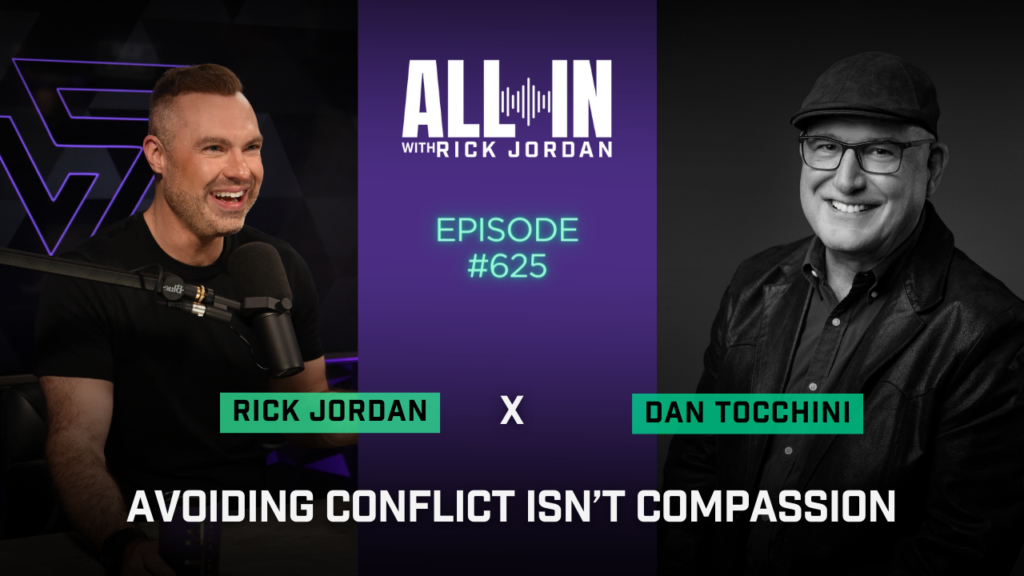
Leadership isn’t clean. It isn’t safe. And it definitely isn’t about trying to look good. Dan Tocchini breaks that illusion wide open. He’s spent decades inside organizations, building leaders, shaping culture, and—most importantly—owning where he got it wrong. One of the most powerful truths he brings to the table is this: if you’re not willing to put something at stake, you’re not actually leading. You’re managing your image.
Dan shares the hard-earned lessons from running a company for over 20 years and realizing that avoiding tough conversations wasn’t compassion—it was self-protection. Performance issues don’t disappear because you soften your language or dance around the truth. They compound. And when leaders avoid conflict, what they’re really avoiding is accountability. Dan calls that out for what it is, and he doesn’t sugarcoat it.
This conversation cuts straight into emotional maturity, conflict, and what Dan calls “paradoxical leadership”—the tension between empathy and enforcement. Caring deeply about people while still holding the line. Being willing to argue well, not to win, but to sharpen thinking and make better decisions. Dan reframes conflict as a resource, not a threat, and explains why leaders who can’t engage it responsibly end up creating far bigger problems down the road.
With nearly five decades of marriage, decades of leadership work, and a lifetime of experience, Dan brings wisdom you can’t fake and perspective you can’t shortcut. This is about leadership with skin in the game—where authenticity, consequences, and respect all matter. If you want to lead people, teams, or a company without losing yourself—or them—this conversation matters.
About Dan:
Dan Tocchini III is a business and social entrepreneur, a published author, a master trainer, an executive coach, a leadership whisperer and a culture development specialist. He is the Founder and Senior Partner at Take New Ground of Take New Ground a subsidiary of Human Performance Unlimited, Inc., where he champions founders & executives to scale their organizations. After 30 years of transitioning individuals, teams, and organizations from their current state to a desired future state of fulfilling their vision, Dan’s passion for leaders makes no question too dangerous and no conversation too difficult in delivering meaningful long-term results. Clients include Disney, ESPN, Microsoft, Interstate Batteries, Nike, Virgin Hyperloop-One, Seigel & Gale, The Oprah Winfrey Network, Gavin de Becker, Jeni’s Splendid Ice Creams, Smarty Pants Vitamins, World Vision, Homeboy Industries, Defy Ventures and many others. After 40 years of marriage, Dan and his wife Aileen live in Horseshoe Bend, Idaho near their two children and 5 grandkids.
Listen to the podcast here
Watch the episode here
Episode Topics:
- You’ll hear what leadership really costs when it’s done right.
- You’ll learn why avoiding conflict quietly destroys teams.
- You’ll gain clarity on empathy versus enforcement in leadership.
- You’ll understand how to argue well without burning bridges.
- You’ll walk away with wisdom only experience can teach.
Rick Jordan
What’s shakin’? Hey, I’m Rick Jordan, and today we’re going all in. All right, today I’ve got a really cool question to ask somebody, and my guest today is going to tell us how to do some amazing things with leadership. Now, I’m a big fan of leadership. I’ve even thought about putting a course together in leadership, just because of some unique styles that I have. I don’t know if they’re unique, but I’ve often said to my team, in my companies that I lead like a baseball coach. I played baseball for nine years, right? I actually go out and I, you know, I’ll high five people. I’ll put an MVP out there, and I’ll say, great job. That was an awesome hit. Good catch, all of that. And then I’ll also be the same guy. I’ll say, Sit your ass on the bench. You know, think about it for two innings. But you know what? You’ve got another bet coming up, so you got to get right back on there. Get your head straight. I’ll teach you what to do. I’ll show you where your issues were, and we’ll work through this so you can get back up there, back up to the plate and hit another solid home run or or single, double, triple, whatever. That’s kind of how I’ve led a lot of the years, a lot of high fives and a lot of direct coaching. Now today, my question as I welcome, I think it’s Dan touchini. I didn’t even ask you how to pronounce your name, buddy. Is it to Chini? Tokini, tokini, tokini. I got you. Anybody speaks English will say touchy? That’s awesome. Welcome to the show, Dan. It’s it’s good to have you, my brother, really good to have you. And this is cool. You’re a leadership expert, right? And I have a question to ask you right away, and maybe this has been asked before of you, but what does it mean to turn leader shit into leadership?
Dan Tocchini
Oh, so you’ve been looking at our website. You know what?
Rick Jordan
I’ve got a great team, man, just like just like the Tonight Show, just like Jimmy Fallon, that binds his stuff for me.
Dan Tocchini
It takes more than you think it does. Always, it takes more than you think it does, and you better be ready to put something at stake. Otherwise it’ll just remain leadership.
Rick Jordan
Oh, that’s intriguing. So put something at stake. That’s interesting to me, because I was about to ask, like, where did you come up with leader shit? Or is that for the people that don’t have the skin in the game? Right?
Dan Tocchini
Right on it’s I want to play the game, but I don’t want to risk losing anything, looking bad, making a mistake, being embarrassed, you know, faltering. And so I think leadership is then some kind of magic formula, or I’m constantly on top, or I’m always the right one. You know, that’s not the way it works.
Rick Jordan
Yeah, no, brother, it’s good. There’s got to be a scenario, right? To where you look back at your own self, because a lot of the things that we develop, like, I like the word leadership. I’ve never seen that before, right? I’m sure you’ve looked back at your own leadership, or most or your leader shit, and came up with that word
Dan Tocchini
It is a confession, you know, I see it out there, but it’s, you know, if you spot it, you got it.
Rick Jordan
Yeah, yeah, for sure. Give me an example of that. Like, when did you actually look back and be like, oh, man, that’s just some shitty leadership.
Dan Tocchini
Well, I had a company I ran for 20 years. What kind of company it was? A consulting it was more of a training, coaching company. I started training work back in the 80s, early 80s, 82 and we started a company called the coaching company. Back then, it didn’t work out, because nobody knew what coaching was, but we did a lot of work inside organizations. We call it consulting, and that turned into
Rick Jordan
Yeah, like, advisory, right? Those old school words, you know, yeah.
Dan Tocchini
But I was running a company for a long time and had multiple, you know, employees 14 years, many of the employees, many of the leadership, most of them, I’d say 97 eight or 990. 9% of them were there for 14 or so years, and it got to a place where I could tell we weren’t performing at our at the highest level. We could not even close. And we had for some time, but we faded. And rather than address it, I tried to become something I wasn’t, you know, tried to be this compassionate to me, it was, I was trying to live up as the imposter syndrome. I was trying to live up to something I wasn’t, yeah, and I was trying to find ways to talk about very difficult issues without addressing them directly. Or, you know, if it got people got upset, I backed off. Like, what kinds of issues? Oh, like, performance issues.
Rick Jordan
That’s a big one, right? I mean, I’ve talked about this in my own organizations from time to time, too, to where it’s I call it like the Yin without the Yang, where, you know, everybody talks about all the amazing incentives, you know, and the commissions and the bonuses, and all the amazing positive things that you can that you can have from doing your job the right way and going above and beyond. But then never, ever really talk about, when it comes time anyways, to talk about the performance issues everybody, like leaders, just tend to run away, because it’s great to talk about all the good stuff they’re doing, right? But then when they screw up, which happens? We’re all human, right? All human things happen. But even more so, it’s not even so much that we’re human. We all have. Need to grow, and you need good leaders in order to point out that Yang to the end to be like, Hey, you screwed up there too, right? So you’re saying that that’s uncomfortable for a lot of people.
Dan Tocchini
They didn’t want to do the exploration. I didn’t want to risk what, you know, they thought of me. We became good friends over the years. I and I was, you know, just full of shit, you know, and in by not really being authentic with them at the time and saying what I was seeing, because I could see things, I I tried to work around it and and the withholding of what I saw was a lie. Was just so, you know, there’s all kinds of shit. If you know, there’s bullshit and there’s rat, you know, you know bullshit is you’re lying, you know. And the unwillingness to talk about what needed to be talked about, or at least talk about it in a very in a way that brought it to the surface where we all could look at it, yeah, I was more about saving myself from the pain of doing that, or the potentiality of losing people that were doing things I didn’t want to do again. And so, in a way, I was trying to be about them, but really it was about me. I didn’t want that back on my lap. I didn’t want to face that I was gonna have to pay.
Rick Jordan
For sure, you turned it into a you problem, right? And that was, that’s an ego thing. Yeah, exactly, yeah. No, I’m hearing you. And there’s a it’s interesting, because there’s a lot of people that say, Oh, I’m not good with conflict, right? And you’ll see leaders that are say, I don’t like conflict. And it’s like, well, conflict does not mean combat. Yeah, I think there’s a lot of that fallacy that exists. It’s like, conflict is actually, it’s a tool, man, it’s a resource. To be able to actually get to a point.
Dan Tocchini
It is the yellow brick road to success. I mean, it’s my the you know, there’s only three kinds of problems. You got a normal problem, you got an abnormal problem, and you got a pathological problem. And I think one of the biggest things I know as a leader, I struggled with for a long time was, which problem do I need to solve first? Because anything you do that’s new is going to bring a new set of problems. Yeah, which problem you always have problems? Which ones are the most one, important ones to deal with? And you really got to think of that in context. So there’s a normal problem, like, if you and I are running a business, and you know, the economy shifts, and we have to deal with, you know, people leaving, or, you know, we have to make cuts, etc, and that that’s a normal problem. But let’s say we have turnover over and over and over again, over the year, or the over the years. That’s an abnormal problem, and probably pathological, so I need to pay attention to that. That’s a tricky, man. Yeah, we have a cash flow problem, right? Yeah, in the first couple of years, that might be so, but after seven or eight years in business, if I’m continually having a cash flow problem, then I’ve got something pathological I need to look at, and I need to go at it, yeah, really put it in the front and center with everybody.
Rick Jordan
I don’t see you ever having a problem with conflict, though, because as I’m hearing you, it’s like, it’s almost like it’s almost like you might be part of your own mafia or something. I mean, that’s, I mean, you’ve got the great last name, and you’re sitting here, you’re talking to me like this, and it’s like you’ve got this pathological problem. And I’m like, just waiting for your hand to go up. I’m messing with you, right? But it’s, but even with that, it’s like I could see the way that you carry yourself, and you’re all smiles here, you know, but I can imagine you in a workplace setting, you know, in a leadership setting, to where you start to now listen, we got to have a talk.
Dan Tocchini
I try to stay calm, but I have, from time to time, got upset, but I welcome it back, by the way, you know, one of the things we I do, at least with our team, and we do it with the teams that we work with, is we work with what it means to be able to argue. Well, right? Yeah, we’re going to argue. It should improve both of our sense of what’s wanted and needed, our sense of logic needs to be sharpened if we’re having a good argument and and usually if we’re arguing, we’re arguing because we care about something. We just see it. We just see it differently. So so many times I’ve had guys, you know, or gals come to, you know, come in and, hey, man, we got to talk about, get into a good argument. And as a result, we get smarter.
Rick Jordan
I want to explore that a little bit, because I wish I had my team here. I’m pulling up my phone because I actually the the meaning of words carries a lot of value for me.
Dan Tocchini
It always has. I am an work. I’m a nut, I’m a nerd. My team gets crazy because as soon as you use a term, I want to go, what do you mean by the term? Yeah, exactly on the same page.
Rick Jordan
Yep, right on. So I mean, as you’re, as you’re talking about this, because I think of, I think of an argument you know, or the word you know, a lot of people will throw that around, you know, almost like conflict in combat, right? They think, at least mentally, it’s a psychological thing, or pathological, as you said, where it’s interchangeable, where people will think that a conflict, you know, whether it’s workplace or even in a relationship, it means combat, you know, so argument, I’m curious, right? Right? And as I’m looking at this, you know, it’s like a reason or set of reasons given with the aim of persuading others that an action or idea is right or wrong, like there is a strong argument for submitting a formal appeal. I mean, it’s almost going like off of what a lawyer would look at. So when you have a lawyer presenting a case in front of a judge, you know, this is why words have, I mean, the meaning of words have so much value to me, because it’s like when, you know, when you talk like partners, right? Husband, white, boyfriend, girlfriend, whatever, boyfriend, boyfriend, and then you dive into, oh, we had an argument, a horrible argument, you know? Or I want to even better man, even better Dan. It’s like when people say I don’t want to argue, you know, but really they’re saying, I don’t want to fight. And that’s the, that’s the conflict versus combat thing again, because they’re relating argument to fighting, when really it’s like an argument, like a lawyer walks into a room, is he fighting with the judge? Is he fight? Is she fighting with the jury? No, they’re presenting a case which is called an argument. It’s like literally saying, This is what I feel, this is how I think, this is my view, you know, and it’s, it’s a discussion, but it’s, that’s why the value or the meaning of words has so much value to me. Because it’s like so many people think argument equals fight, just like conflict equals combat. This is getting really good, man. I mean, I’m glad you brought this up.
Dan Tocchini
If you hit it on the head. I mean, I, when I talk with the executives I work with, I talk about our argument is the art and science of effective reasoning, and that we’re actually going to be it’s a cooperative activity, yeah, and I’m going to get passionate for what I see or what my perspective is. And I want you to to be however you need to be, to be to get your point across, and I let them know. Look, I’m going to argue, I’m going to state my my claims, as if I’m right, but I want you to know I’m listening as if I could be wrong. And I need you to to, you know, address what you hear in congruent, so that we can sharpen and make the best decision out of it, dude,
Rick Jordan
I think we’re going to chop that down to chop that down to a clip in a real because that was incredible. What you just said, right? You’re going to state your your opinions as if I’m right, but my ears are going to be open, listening in case I’m wrong, as if I’m wrong.
Dan Tocchini
I’ve been married almost 50 years.
Rick Jordan
Dude, Okay, how many years into it did you finally figure that out? That’s what? 3535 Yeah, that’s good, at least it wasn’t 49 right?
Dan Tocchini
Say, the last 15 or so years of my life have been the best and most peaceful and enjoyable.
Rick Jordan
Right on with my 50 years almost. Just want to draw attention that real quick. So when did you get married? I mean, I can obviously figure it, but 1921,
Dan Tocchini
60, I’m 16. I’ll be 69 in December. Wow. And I married my wife when she was I was 26 and she was 23 I think 2120
Rick Jordan
Okay, so you’re like, at 40 something years, yeah, so you’re rounding up to, that’s still incredible, man.
Dan Tocchini
I mean, it’s, yeah, I was 23 I was married at 23
Rick Jordan
Okay, so you like, yeah. So you’re like, almost 4547 years into it. 47 years. Yeah, yeah, wow, man, that’s incredible. First, that’s awesome. You know, good job sticking through it and pushing through it. I mean, I’m sure there have been, like, if you look back, right, there’s been ups and there’s been downs, and it’s almost kind of, I’ve written a book about, I’ve written books about, that’s great, yeah, but it’s when people can see roller coasters too, you know? And it’s be like, Oh, we’ve had the highs and the lows. It’s like, I don’t think that that’s the case. When you look at you and you like you reflecting back, you know, people in relationships, sure, they can look over a short period of time, maybe a year, and see the highs and the lows of a relationship, but when you look at a span of 50 years like you’re saying, I would think and correct me if I’m wrong. But could you not call those more of a season, or seasons rather than highs and lows.
Dan Tocchini
Oh, yeah. I mean, I met her when she was 16 and I was 19. Wow, so I could have been arrested, created agreement with her mom. Thank God it was an old involve, a
Rick Jordan
Little bit of a payoff.
Dan Tocchini
They were both from the old country, but, but so I knew her very young, and we split up before we got married, and went through a lot. And we got married and went through a lot, you know, it was quite, quite a dance. But I think, like any relationship, it requires a willingness to be committed to something bigger than your own self, which I really didn’t get a hold of till about 10 years into the relationship. Wow. I started to get a hold of it.
Rick Jordan
Then that’s amazing, man, I appreciate you. I really do because I think you have a lot to teach people. It’s because, quite literally, you’re 69 years old. I did an episode just me, a solo episode A little while back, talking about my grandmother and how she passed when she was 93 you know. And it’s like I’m 44 and I love having conversations with those who are, you know, like, 20 years and more to my elder, and I say that my dad’s 90 he’ll be 91 Oh, dude, he’s still that’s amazing. That makes me so happy for you. For real. Because you still have, you still have that that’s like, like, blood relative that you’re able to look up to and talk that way.
Dan Tocchini
I mean, he’s here just present, like anybody. He runs his business. He goes down to the office, usually sleeps for a long time, but makes deals, and then goes home every day. You know, is he loves it.
Rick Jordan
That’s great, too. Because, I mean, when you look at that and I hear people like, Oh, I’m to retire at this age, you know, or or, like, this big thing for a lot of people who are 25 and 30, I hope you’re listening right now, which is most of our audience, right. Perk up your ears for this is that I don’t feel like there’s ever an age in life when you should be retiring, or actually you should be going towards retirement. Be like, I’m gonna make so much money, then I’m gonna retire, you know, because just like, just like Dan and I are talking here, there’s seasons in your life, yeah, and you can go through seasons of education, making a lot of money, and then going back and recycling and learning more and making more money, and then, you know, buying more amazing crap, right? And then learning. Go through, going through a season of learning leadership and excluding leader shit, and then you go through another season, and then you get to a point to a point to where it’s like mentorship, like Dan is right here, to where you can look back and be like, This is my place in life right now. I write books, I talk to people, I tell them what I know from what I’ve experienced over the last 50 years of my life.
Dan Tocchini
And I love to work too. I I love to get in it with the teams. I do a lot of work with startups, and we do, I do. My specialty is establishing culture through leadership in the organization. So we, I do a lot of work with boards and leadership teams, you know, and and those communications between, you know, the governance and, yeah, the execution and operative, opera, operationalization of, you know, strategies, that’s a big word.
Rick Jordan
I wouldn’t attempt it.
Dan Tocchini
I couldn’t listen. It’s a miracle that came out.
Rick Jordan
Yeah, that’s awesome, dude. I appreciate you. I mean, I’ve had so many questions on here. There’s one more. There’s one more that I want to hit before we close out today, because it was intriguing to me, right? Obviously, we hit the leadership versus the leadership, but paradoxical leadership, yeah. What do you mean by that? Can you elaborate on that a little bit? Because you talked about this a lot.
Dan Tocchini
Right earlier, we were talking about, you know, the kind of how I blew that company up, yeah, you know, and I was struggling in a paradox. A paradox is a tension that exists that we navigate. You don’t resolve a paradox. You don’t you know there’s no answer to it. You’d have to learn to negotiate it. And the paradox you and I were talking about in that moment when I was telling that story, is the paradox between empathy, which is creating affinity with people, which you need. You know, they get that you care about them, and what they’re up to and enforcing is the other aspect of it, enforcing what’s needed and necessary and what holds the game in place, right? Yeah, you know that’s everything from contracts to deliverables, you know, everything you’ve got in place. So that tension between maintaining an empathic or affinity with the people you work with, and also enforcing what’s wanted and needed is a paradox. And there are, we’ve identified quite a few, like more than 14.
Rick Jordan
But it’s an interesting balance, isn’t it? And it’s something that’s not very easily obtained, and probably something. I mean, I know, I I’ll even struggle with it at times, because I genuinely want what’s best for people, but that what’s best for people is, like, I have to try to balance because I’ve got, you know, you know, almost 100 employees in a public company at the same time, I want what’s best for that person in their own life, right? So it’s like, you don’t want to destroy a person by not giving them a chance. You want to help a person, but then there’s you have to say, Okay, what’s my threshold? What’s my time period? So I’m just going to tag on a little bit. There’s probably boundaries and certain thresholds you need to have for yourself that you understand, right?
Dan Tocchini
Yeah, there are consequences, yeah. And you know, to to discern the asymmetries in the process, requires an ability to inquire and to weigh what the prices and rewards are, and I have very specific frameworks to do that. That’s incredible, yeah. And the other thing is to be able to have hard conversations that will deepen the relationship, even if it’s going to break apart, that there’s a respect and a deepening of the relationship, yeah, and I think that that requires an authenticity that many leaders aren’t willing to do. And that’s where the leadership comes in. Is, you know, like trying to lying about what you’re up to, or trying to make it about the other person, when it’s really some preference you have for sure and you can’t see exactly how it’s good for the other person. Yeah, like, that’s when the leadership starts to leak in.
Rick Jordan
Oh, man, we got to plug those holes. Brother, for real, Dan, dude, thank you for being on today. This has been an amazing conversation. We went a little deep, you know, got into some awesome concepts, and I feel like we’ve only scratched the surface, everybody. I think you need to go follow Dan at. Dan tokini right at Dan, underscore tokini on Instagram, and amazing dude, I’m telling you, reverting back to this, I love talking to people like Dan who are to my to my senior to my elder. Just because of the breadth and wealth of knowledge that that guys like Dan right here incorporate into their lives, we can learn something from everybody, and especially those. Look at those who are older than you, to be able to look up to them and gain their knowledge and experience because they paid the dummy tax, right, Dan, so that we don’t have to you got it well. Thank you, brother. Thanks for being on today.
Dan Tocchini
Thank you. It’s wonderful being with me.