
About the Episode:
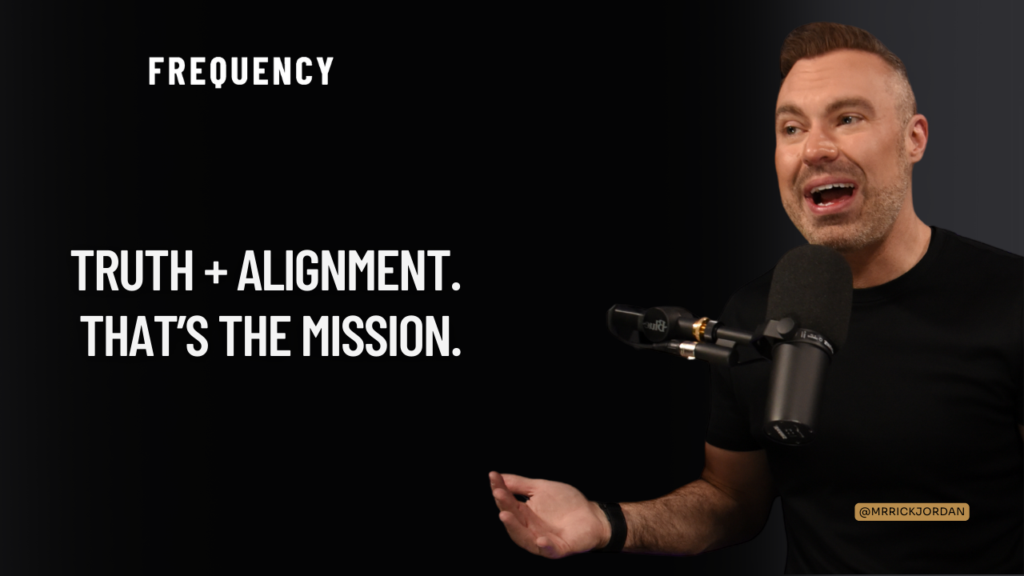
Today is a big day—because as of right now, the show you’ve known as ALL IN is officially FREQUENCY. And no, this isn’t me “starting over.” All In is still part of me, and it always will be. To me, being all in has never meant giving 100% all the time—it means giving 100% of what you have today. Some days you’ve got 30% in the tank, and if that’s what you’ve got, then give the full 30% with integrity. Other days you’re at 100… or 120… and you floor it. That gap between 30% and 120%? That’s where the concept of frequency comes in. I’m recording this from an airport because this idea literally hit me in motion—thinking about the way wireless signals work and how low frequencies penetrate deep while high frequencies move fast and pack a ton of information. That’s life. There are seasons where you’re meant to soak in the deep stuff—the slow, penetrating episodes and lessons that get into your soul and build foundations. And there are seasons where you throw on the afterburners, pound down a couple Red Bulls, and go execute. The problem is when you live in one mode too long. This rebrand is about teaching you how to recognize what season you’re in, what frequency you need, and how to shift with intention. Going forward, FREQUENCY is about two things: truth and alignment. Real truth—whether it hits you fast or takes time to settle—and the alignment that comes when your decisions match who you actually are. If that’s what you want in your life, your business, your relationships, your health, and your parenting, then hit subscribe and come with me. We’re not ending anything—we’re tuning in to what’s next.
Listen to the podcast here:
Watch the episode here:
Episode Topics:
- This is the official launch of FREQUENCY and the new direction of the show.
- You’ll get a simple framework for when to go deep and when to go fast.
- Rick explains why “all in” doesn’t mean 100% every day—it means 100% of what you have.
- You’ll learn how living in one mode too long creates problems.
- The mission is clear: truth and alignment—and this episode sets the tone.
You are meant to soak in those deep, low frequencies and just let them penetrate deep into your soul. And there are times when you’re supposed to throw on the afterburners, pound down a couple of Red Bulls, and just go after whatever it is that you need to go after.
What’s shakin’? Hey, I’m Rick Jordan, and you have tuned in to frequency if you’re looking for all in, that’s the last 600 or so episodes before today, because as of today, the show is frequency, and I am grateful that you’ve tuned in. You’re going through life, and just the old skin doesn’t feel quite right. It’s not that you want to completely shed it, because there’s still so much of that that’s part of you. And there’s still so much of all in this part of me. Someone asked me many times before, actually, guesting on different shows, and on this show, it’s like, what does all in mean to you? Rick and all in to me have always been giving 100% of what they have today. That doesn’t mean you can give 100% all the time, because some days you wake up and you feel like, Man, I just got 30% of the tank, and that 30% is all I can give. But if that’s what I’m going to bring to the table today, you know what I am all in for today, and whatever I need to do today, and I’m going to give that full 30% that 100% of 30% that I have in my tank, because I’m all in.
And there are other days when you can just floor, and you’ve got 100%, some people feel like they’ve got 110, 120. I’m gonna give that today, because that’s what I’ve got, and that’s how you approach your days. It’s how you approach your life, it’s how you approach work, business relationships, being all in well, if you notice, there’s kind of this, this gap, this delta right in between that 30% and that 120% that’s different frequencies. To tell you how this transpired, and this is really going to resonate with you, because going forward, this is going to be awesome. So please, help us, and you can be a part of this with me by subscribing to the show as we go on this journey together. So I was actually walking through the airport. Ironically, this is pretty, pretty cool is that I’m actually in an airport right now. I’m in one of those phone booths inside the United Airlines clubs, and I’m recording this show. So as you’re listening to it, it’s like I actually have like people next to me. I mean, on video, there are people walking behind me outside of this thing. That’s how I started to think about this several months ago. I was walking, if you’ve ever been to O’Hare in Chicago, because that’s my home base for me, there’s this tunnel that connects all of the terminals, one, two, and three.
And I’m walking down there, and it’s underground. It goes underneath a lot of the pickup and drop off, and even where the planes go. And I’m looking up, and I see, in the upper right-hand corner, I see these radios, and they’re cell radios. It’s what your phone communicates with. And I’m looking at those things, I’m just wondering, it’s like, Man, I wonder what frequency those are operating on, because I’ve always had this thing in me to where I’ve like, had to stop and look and wonder, Does that thing belong to AT and T, does it belong to Verizon? Who does that belong to? And I’m looking up at this, I’m like, man, you know, I’m a spiritual dude. It’s like, God, am I meant to do something with communications, like with radio signals, and ironically, as I even say that now, like communications, that’s literally what this show is all about. And I love delivering a message to people, and I’m looking up at it, and I’m like, I’m gonna have to really think about that. And then I start digging into my soul for this, and I think it’s like, how did I get interested in this? Because I have followed the trajectory of companies like T-Mobile and how they acquired Sprint, and the whole reason for acquiring Sprint, way back when, if you remember this, is to actually add on spectrum, the 2.5 gigahertz spectrum, the mid-band, which is their super-fast spectrum, when they pretty much had none. And that’s really what boosted them and catapulted them into the major player they are today. Otherwise, they were going bankrupt a few years ago, and AT and T was actually looking to acquire them, but when that deal fell through, they got a breakup fee of a billion dollars.
This is when John Ledger was CEO, and he turned this thing around, and he ended up buying Sprint, merging with Sprint, and gaining all of this spectrum, this, this mid-band frequency, and that’s what put them. And so really, what many feel is the number one wireless carrier in the US today in the country. Though I’ve followed this stuff my whole life, and I thought back to when I was it was 10 or 11 years old, and I had this dude in my life. I’ve mentioned him before somewhere over the last 600 episodes of all in so where he was kind of like that role. I don’t know if you’ve ever heard of Big Brother, Big Sister, where there’s someone that comes along who is not your sibling, but they’re a decade or 15 years older than you, and they kind of are like that, really older brother, really older sister, that kind of helps guide you through life. You know, a different role than parents, absolutely. And this was even before my dad passed when I was 16, but he was there in that position in my life. And I remember driving was 10 or 11, and he points up at this big, huge tower now. And this is in the days, if you remember this, this is in the days of bag phones, right? And I don’t know if you ever had those, but that’s the first type of cell phone that I was ever introduced to. These things were literally in, like this satchel, and, you know, the cover went over the top of it.
They were usually leather, and they kind of velcroed together. But in this thing was like this, this large base unit, the whole thing, maybe weighed like seven or eight pounds. It had a strap to carry. It had a battery pack that was there, but then you would also plug it into the DC socket, which was a cigarette lighter socket in vehicles, to power it when you were in the car or charge the battery. And this thing picked up. It had a handset, right? Had a cord attached to the handset that went to the base unit inside this bag. And he had one of those. He also had a fully installed system that was called car phones, right? The same scenario was a handset that you would pick up just like today. It would be like an office phone that still has the cord. You’d pick it up, and then that would be attached to the base that was permanently mounted in the car. And these things would communicate up to these towers. And he’s telling me about this, and he points, just like, look at that over there. That’s a cell tower. And at that point, I went by the name of Ricky. My dad was actually Ric,k and I was Ricky. Little bit of an aside. I’ll tell you about that on how that took place some other episode. But he goes, Ricky, look at that. And he starts telling me all about the cell phone tower and how, at that point, there were only two carriers in every single market. You know, today, we’ve got lots of them, right? We’ve got Verizon, T-Mobile, AT and T, we’ve got Mint Mobile, we’ve got US Mobile. We’ve got visible.
We have all these different carriers. Well, back at that time, there were only two. One was the A carrier, one was the B carrier, and they operated on different frequencies. He starts telling me all about these things and how there are low frequencies, right? I don’t know if you’ve ever been in physics at all, or even in trigonometry, but they’re really like sine waves. You know, you see waveforms, how they go up and down. Just imagine that. I know everybody’s seen those waveforms that go up and down. Well, he’s talking to me about these low frequencies at first, and he’s like, that tower over there is super high, and it broadcasts low frequencies. And that waveform is super wide. It goes high and low on the graph, if you look at it this way, and it kind of goes across that way, right? And these are really long waveforms. And those have special properties to them, because they’re these really long waveforms, and they cover this actual physical area of air. They can go super far, super far. And they can penetrate buildings really, really well. They can penetrate materials because they are low frequencies, which means that they can get deep inside. And then he tells me about high frequencies, and high frequencies have really narrow waveforms, really, really narrow, and those are meant to go really short distances, but they go really freaking fast. They don’t penetrate buildings very well.
But in today’s age, if you’re looking at your phone in some areas, right, you’re like, Man, this isn’t really like, and you’re in a building,g like, I don’t have the speeds that I should be getting. You know, Instagram’s not long, tick tocks not loading very well, or it’s slow. That’s because of the low waveforms. The low frequencies are the things that are getting into the building to penetrate. You know, if you’re in a basement somewhere or in an elevator, you know it takes longer to load, you can make phone calls in there, no problem. And that’s still the primary like emergency scenario, because those still run on the low wave forms, and they can penetrate. Well, that way you can absolutely be sure you can be connected almost wherever you are now. However, when you get outside, you know, and even inside nowadays, it’s better. But when you get outside, and you have these super high frequencies that have these super short, narrow waveforms. Move really, really quickly. You can pack a ton of data, a ton of information, into those; they carry so much data, but they go fast, and they don’t go far. So as he’s explaining all these things to me, I just kind of grasped onto this whole thing. I’m like, holy cow, this concept, and it starts resonating with me. And that’s where the name of the show came from, going from all into frequency.
Because as I take a look back at how I communicate, right? Communications, like, am I supposed to do something with wireless signals and all that? I mean, I still don’t know. I don’t think so. It’s like, no. It’s like, what I’m doing is what I’m doing now, it’s bringing a message to people. And if you’ve listened to the show, if first, thank you, if you’ve listened to this show for a while now, you know that there are some episodes, like, literally, to where they can be two hours long with guests, and I’ve had these right? Or I’ve had two partners because they’ve gone so well, and just great conversations. Those are the low frequencies, the ones that move slowly, that have these really high and wide waveforms. They penetrate deep into your soul, and it’s just this awesome, awesome thing that you’re supposed to take with you, that’s supposed to just sit deep inside of you, and then if you’ve listened to the show again, thank you for being part of this thing. There are some episodes where it’s just me talking, like today, and we call them solo episodes, where they’re five minutes, and I am fucking fired up. I am fired up, and I’m just hammering home on some points. Those are really, really high frequencies, and those are meant to get, like, people pumped up, right? I’ve done keynotes before, keynotes that are 45 minutes, hour-long from the stage, and then you know, to where, you know it’s, it’s paced, right? And there’s a combination of high frequencies to where I’m really excited, I really drive home, and I’m talking really quickly. But then there are moments in those talks too, where I’m just talking slower and just really getting into deep concepts, things that are meant to really just forge and resonate inside your soul.
And on those episodes that are just five minutes long, that’s the same thing as, like, when I’ve opened up for people before. I remember one time I opened up for a for Michael Chandler, you know, the UFC fighter, at an event, and I’m up there, and my slot, I was literally there, if you want to call it as like the hype man, right? That was my role. I was there for seven minutes. That’s how much time I had. And when I come off stage, I mean, I just went balls to the wall when I come off stage, a couple of deals going like, Man, I just want to run through a wall right now. I’m ready to, like, go take on the world. I’m ready to just crush some business, close some deals, and go find a wife. You know, they’ll do all these things. You know, just change my purpose, find my why. I mean, all of these cliches, right? Coming out, and I was only on for seven minutes, but that’s what it was meant to do, to get people into a state, right? And that’s what high frequencies are great at, is getting you into a state, but they don’t last long. They pour a ton of information into you, those high frequencies, and you’re supposed to pick and choose what you want out of those, because there’s almost no way you’re going to remember almost any of that or all of that stuff. You’ll remember some, but not all. And they’re meant to get you into a certain state, almost to where you can kind of get ready to get the deep stuff, those low frequencies.
And this is pretty cool, because I take a think back to that’s a cool phrase. I take a think back. I catch myself. You’re gonna hear that if you’re just tuning in right now, like, first time ever, I kind of catch myself in phrases too. It’s like, that’s, that’s cool. I’m gonna have to try to remember that one. I take a think back to even when I was, I was a worship leader in churches. And this is true of concerts, everyone. This is so true of concerts. I mean, you could go see Nickelback, and it’s the same, right, if you look at a set list, because the purpose when I was in the church, I don’t know Syndicate, I don’t know what you call it, the system, right? Were the set lists made to, or even that entire time was made to be something that opened you up to what was going to happen during the rest of that service, to hear the words that the pastor was going to speak? And I, you know, being a pastor myself, I I used to do the same thing, right? You would want something that would prep people rather than just going up. It’s the same as, like, an opener or something. But I’m telling you, if you get I’m sure most of you have been to concerts. When you go to a concert, the set list is the same.
It’s made intentionally of rises and falls. You know, I can imagine Nickelback, right? They’ll come out and do this hard-hitting nine. Number, you know, I’ve seen videos, and they usually close with something like burn it to the ground, right? If you’re a fan of them, I am. Actually, you can love it or hate it with them or me, whatever, but burn it to the ground, which is this intense thing that they end with, to keep you on this high note, right? But then at the beginning, they kind of do the same thing. And somewhere in the middle, if you know, Nickelback, they would throw in songs like photograph, right? These almost ballot in sounding things, so where it’s like they’re meant to stir up these emotions in you, these deep-seated emotions, which is kind of how they’re written now. And you get, you can name any artist. It’s just the first one that came to my mind, but you can name any artist, right? I mean, go with Google dolls. I mean, you can tell I’m 46, right? Because I’m talking about all these bands from the 90s and 2000s here. But you can even pull it out and think of Ed Sheeran, same scenario. He’s got songs that have, you know, 120 beats per minute. They’ve got some great bass lines to him, you know, and they’re really pumping. But then he’s got other ones to where he ones to where he can go into love songs and those, I’m sure, because this is what they do, the artists do, is they put those kinds of in the middle, and they’re made to stir up these emotions. And you go through this entire emotional ride.
And that’s the experience of the show. And this is where it started really sinking into me after just walking through the airport. It’s like, that’s what this show is about, even greater and deeper than that is, that’s what life is about, that you’ve got times to where you are meant to soak in those deep, low frequencies and just let it penetrate deep into your soul. And there are times when you’re supposed to throw on the afterburners, pound down a couple of Red Bulls, and just go after whatever it is that you need to go after now, if it’s business, if you’re building something, it’s like, you know, I know that. I mean, taking a company public two years ago, there were times when it was like, Man, there was a lot of urgency behind a lot of things. And now I’m in a stage where it’s like, it’s time, you know, it’s time to go into deep frequencies within the company to build a foundation. And as I look back at life, whether it’s in business or even in relationships, it’s like, can you imagine, right, starting out a relationship? Right? Most relationships, when you start out talking romantic relationships here, they start out on the high frequencies, right? You’re tuning in to the rush to this powerful moment on the first hit, the second date, and, oh, my God, then maybe you sleep together.
It’s like, oh, that’s like, you know, at least I hope for you, anyway, that it’s like, out of this world, you know. But I mean, if it’s bad, then you probably don’t see him much any longer. It’s all this high-frequency stuff, all of these firsts, right? And you’re going at it, but there’s a moment, right? So, where you start to think it’s like, That can’t sustain you. That would be a fake life, because you’re gonna have hardships. If you have any intention. And some people, you don’t have any intention to have a long-term relationship with them, that’s okay. But you know, if you start to think it’s like, man, we’ve been going together now for three months, four months, six months a year. It’s like, where is this going? You start to have those thoughts, is this somebody that I might want to continue with for a long, long time? And that long time is going to be a lot of low, long frequencies, a lot of the deep because you’re going to have the moments to where you have to have that foundation of the deep in order to survive the moments of high intensity, high frequency, whether that’s good, like amazing things you’re doing, like the rush of having your first kid with that person if you decide to do that, or maybe the high frequency of, like your first argument or a really hard conversation that you’re both heated about.
In order to survive those high frequencies, you have to have the lows as well. So all the way back to the cell providers, right? There are purposes to both of these things. I’ve had this at events too, where I’ve gone, and it’s been so intense at these events. I remember the first Funnel Hacking live I went to, right with Russell Brunson. I actually had two events back-to-back where I just booked myself. This was like seven, eight years ago, back to back, where I was just learning. I was attending. I wasn’t speaking, I wasn’t doing anything as part of the event, except being there to learn, that’s it. And after being in that first event, the first Funnel Hacking lab I ever went to, the first one, after being there for two days, I got so much information. Because if you’ve ever been there, or any event like that, or like a Tony Robbins event, anything like that, you get. It pumped full quickly of all this intense download of data. Remember what I talked about about high frequencies is that it can pack a lot of data, it carries a lot of data super quickly. You can download so much so fast. And then I’m like, time out, and I straight up canceled the next week. I didn’t even get a refund for the tickets. For the next week, I got the hotel back Rick, I could reuse the airline funds, but the event ticket, I didn’t get a refund for the event ticket because I’m like time out.
I need to take what I’ve gotten now that I just got this super quick download, you know, these, this high frequency information, and I’ve got to go do something with it right now. I’ve got to put it into areas of my business, of my life, so that I can actually sustain this, because if I go like, I’m going to forget half the stuff I just learned. So I’m going to go in stages, right? I revved it up for 48 hours straight, and I’m like, let’s dial it back. Let’s downshift a little bit into a lower gear, into a tune, into a lower frequency, and put this stuff in place. Now, some things I put in place right away, right? I kept it, I kept it tuned high to a higher frequency, to put it right away and move quickly. Some other changes that I needed to do in business anyway. At that point, it took a little bit of time to implement, and that’s because you have to strategize. You have to plan, you have to make sure that what you’re doing is going to be sustainable. There are different purposes for high frequencies and different purposes for low frequencies. That’s what you’re going to hear a lot on the show you already have, but the rebrand is completely focused on that. And the biggest thing that I’m going to tell you the frequency is going to be bringing truth and alignment. Those two truths and alignment.
So if you don’t want either of those things, this is not the place to tune in. But if that’s something you want to face, truth in all of its forms, things that show you that you can change right now, today, and maybe some other things you’ve got to think about and change over time, those high frequencies, those low frequencies, right in order to get into alignment with you. That way, everything else around you can start to put into alignment with those things, and you can start to learn the purposes of the high frequencies and the low frequencies in your life, and what you need to tune into at what point in time in your life, in your business, in your relationships, in your health, in parenting, all of those, because there’s so much that You can take out of both of those. They’re equally important, tuning into both high and low frequencies, but the purpose is different, and even more so, the timing is different between those two. There are benefits to both, and there are also problems to both, if you stay in one too long. So this show is 100% about truth in all of its forms and alignment. If you’re with me on that, hit subscribe, because this is going to be an awesome, awesome ride. All in was shot like 600 episodes, something like that. Let’s go for 600 now, and that’s going to be you can go back and listen to all the all-ins that do it, do it. I encourage you to do it. And going forward, tune into frequency.